
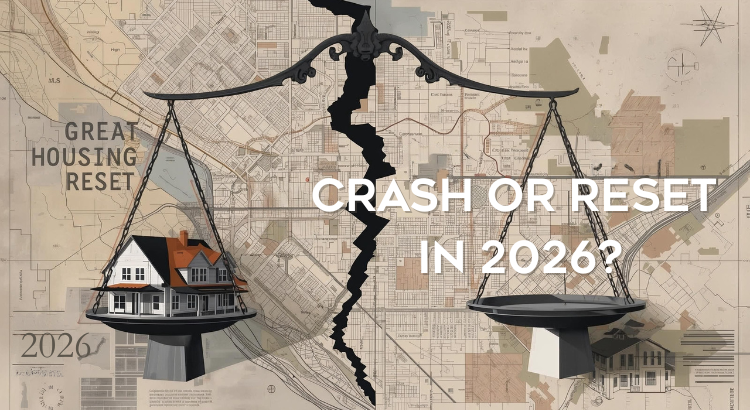
If you spend any time on social media, you’ve probably seen the posts:
A housing crash is what Gen Z and Millennials are praying for. (as one X post recently put it)
A housing crash is what Gen Z and Millennials are praying for BTW https://t.co/ZYciZ0bpdB
— Lauren Chen (@TheLaurenChen) November 30, 2025
With home prices and payments stretching far beyond what many younger buyers can afford, it’s understandable that some are hoping for a 2008-style reset that suddenly makes everything cheap again.
And there is at least one analyst saying that could happen. Housing analyst Melody Wright has warned that U.S. home prices could fall by as much as 50%, calling for a correction that could be “worse than 2008.”
But when you step back and look at what most major housing economists and forecasters are saying about 2026, the picture looks very different. Instead of a crash or a huge rebound, they’re mostly calling for something in between:
A slower, more balanced year that many are labeling a “reset.”
Let’s look at that national picture first, and then zoom in on what it likely means for Orange County and especially Irvine.
Why So Many Younger Buyers Are Hoping for a Crash
Millennials and Gen Z have spent much of their adult lives watching home prices sprint ahead of wages. Incomes have risen, but home values and mortgage rates have often moved faster, especially since the pandemic boom. That’s pushed the first-time-buyer starting line further and further away.
So when a headline pops up saying prices could plunge by half, it spreads quickly, especially on X and TikTok, where frustration about housing affordability is a constant theme.
The logic is simple:
- If prices fall dramatically,
- and rates drop at the same time,
- maybe long-shot buyers finally get their chance.
The risk is that people organize their entire life plan around an outcome that most experts don’t actually expect.
The 50% Crash Warning Making Headlines
The more dramatic prediction making the rounds comes from analyst Melody Wright, who has warned that median U.S. home prices could fall by around 50% nationally, with even larger drops in some areas, in a correction she believes will be “worse than 2008” and could “devolve a lot faster than last time.”
Her argument focuses on:
- Stretched affordability
- Vulnerabilities in certain markets
- The possibility of a sharp correction to bring prices back in line with incomes
It’s important context. Housing markets can go down, sometimes quickly. But it’s equally important to recognize that this is one view, and it’s very much on the edge of the forecast spectrum.
To understand what’s most likely, it helps to look at what larger forecasting groups, data firms, and trade associations are projecting.
What Most Economists Expect for 2026: A Reset, Not a Meltdown
A recent roundup from Real Estate News pulled together forecasts from Redfin, Zillow, Realtor.com, Bright MLS, NAR and others. The common thread:
- Existing-home sales are expected to rise in 2026-but only modestly. Estimates range from roughly +2% to +14% versus 2025, with many clustered in the low-single digits, still below pre-pandemic levels.
- Mortgage rates are expected to drift down, but not crash. Most forecasters see 30-year fixed rates in the low-6% range, with some calling for an average around 6.0–6.3%.
- Home prices are expected to be roughly flat to up slightly in 2026, not soaring, and not collapsing.
Redfin has even put a name on it: “The Great Housing Reset.” In their 2026 outlook they expect:
- U.S. median sale prices to rise about 1% year-over-year
- Existing-home sales to climb roughly 3% to around 4.2 million
- Mortgage rates to average around 6.3%
- And, for the first time in a long time, income growth to outpace home-price growth, slowly improving affordability
That doesn’t sound like a fire sale. It also doesn’t sound like the double-digit price spikes we saw earlier in the decade. It sounds like a market catching its breath.
California’s 2026 Outlook: Slow Thaw in a High-Cost State
Zooming in on California, the California Association of REALTORS® (C.A.R.) projects something similar: a slow thaw, not a surge. In their latest forecast for 2026, they expect:
- Existing single-family home sales to increase modestly from 2025
- The statewide median price to grow in the low-single digits
- Mortgage rates to average around 6%
- A slight improvement in the affordability index and inventory levels
At the same time, California still wrestles with a long-running housing shortage. That limited supply is one big reason many economists are skeptical of a 50% statewide price collapse, there simply aren’t enough distressed sellers or excess inventory right now to trigger that kind of scenario in their base case.
Instead, they see a market that’s:
- Still expensive
- Gradually adjusting to higher rates
- Held up by tight supply and relatively strong owner equity
That description fits Orange County and Irvine especially well.
Orange County Heading Into 2026: Slower, Not Sinking
To understand what 2026 might look like locally, it helps to start with where we are right now.
According to the Orange County Housing Report for late November 2025:
- Orange County had roughly 3,900 active listings, still well below the pre-COVID average (which was closer to the mid-5,000s).
- New listings from January through October were about a quarter lower than the 2017–2019 norm, a sign that many owners are still “hunkered down” in their low-rate mortgages.
- Expected market time (the number of days it would take to sell all listings at the current pace) was about 84 days-almost identical to the pre-pandemic average of 85 days.
- Closed resales were up modestly year-over-year, with homes selling for roughly 98% of list price on average. Distressed sales were essentially a rounding error.
In other words:
- The market has slowed compared to the frenzy years.
- Buyers have more time and occasionally more room to negotiate.
- But prices are not in freefall, and distress is rare.
Layer on top of that the normal winter/holiday slowdown, and it’s easy to see why 2025 feels quiet. The question is what happens as 2026 unfolds with slightly lower rates and a “reset” dynamic instead of a boom or crash.
Irvine’s Late-2025 Snapshot: Slower Pace, Still Tight and Price-Sensitive
Within Orange County, Irvine is a helpful example of what a reset looks like on the ground.
Recent Irvine data shows:
- Around 770 total listings, with roughly 600 active and about 216 new listings in the last month
- Roughly 164 pendings, down from the prior month
- Months of inventory running around 2.0–2.5 months (about 2.3 most recently)
- Median days on market rising into the 50–60+ day range by fall 2025
- The number of price reductions climbing from under 100 late in 2024 to a peak near the mid-200s in mid-2025, before easing a bit into the high-100s
At the same time, the Orange County expected-market-time graph shows 2025 tracking in the 80-day range by late year-clearly slower than the last few years and right around “normal” pre-COVID levels.
Putting that together, Irvine’s market today looks like this:
- Homes are taking longer to sell than they did during the pandemic boom.
- Inventory is still relatively low, 2 to 3 months is not a buyer’s market.
- Buyers are more price-sensitive, and overpriced homes are the ones sitting and cutting.
It’s not a distress story. It’s a “be realistic” story.
And it’s exactly the type of environment you’d expect if the national and California “reset” forecasts prove roughly correct.
If You’re a Millennial or Gen Z Buyer, What Should You Hope For in 2026?
If you’ve been priced out of Irvine or the rest of Orange County, a 50% price drop sounds amazing. But if that doesn’t happen-and most forecasts say it won’t-waiting for it can keep you frozen in place.
Here’s what the mainstream “reset” scenario could offer instead, if it plays out:
- Slower price growth: Nationally, Redfin expects prices up about 1%, not 10%. California’s forecast is similar-low-single-digit growth instead of spikes.
- Slightly lower mortgage rates: Economists generally expect 30-year rates to average somewhere in the low-6s, instead of the higher-6s we’ve seen at times.
- Incomes slowly catching up: Redfin’s “Great Housing Reset” theme is that income growth finally outpaces home-price growth for a stretch, which gradually improves affordability.
- More negotiating room on specific homes: In markets like Irvine where days on market have stretched and price reductions are more common, serious, well-prepared buyers can negotiate on homes that have been sitting.
That still doesn’t make Irvine “cheap.” But it does mean:
- You may have more time to think,
- Less competition from 20-offer bidding wars, and
- A better chance to find a home that works for your budget and timeline, especially if you’re flexible on features or location within Orange County.
For many Millennial and Gen Z buyers, the more practical strategy for 2026 will be:
- Run the numbers with a trusted lender at today’s rates, not fantasy rates.
- Decide what payment you’re actually comfortable with.
- Use the slower, more balanced market to shop strategically-especially for homes that have been on the market longer or have taken a price cut.
- Remember you can always refinance later if rates move lower, but you can’t go back in time and buy the home that fit your life when you needed it.
What 2026 Could Mean for Orange County & Irvine Homeowners and Sellers
If you already own a home in Irvine or elsewhere in Orange County, a 50% crash headline is terrifying. The consensus “reset” view paints a very different picture:
- OC owners, on average, have solid equity. Distressed sales are extremely low.
- Demand hasn’t disappeared. It’s just become more selective and sensitive to price and monthly payment.
- Market times are normalizing. An 80-day expected market time in OC or 50–60 days on market in Irvine isn’t a sign of collapse, it’s closer to what used to be considered normal.
In 2026, if the forecasts are close, sellers should plan for:
- More realistic timelines. Weeks or a couple of months on market may be typical, especially outside the hottest price bands.
- The need to win on presentation and pricing. With more options and higher payments, buyers are quick to ignore homes that feel overpriced or under-prepared.
- Some negotiation. Think more along the lines of small credits, repairs, or modest price adjustments, especially if feedback slows, not fire-sale discounts.
For well-priced, well-prepared homes in good locations, a reset market can still produce excellent results. The key is aligning your expectations with what today’s buyers see and feel.
Building Your 2026 Game Plan in the Middle of All the Noise
So where does that leave you if you’re thinking about a move in Irvine or anywhere in Orange County?
A few practical takeaways:
- Don’t build your entire plan around an extreme forecast, good or bad.
One analyst calling for a 50% crash doesn’t mean it will happen. Likewise, we shouldn’t assume prices only go up. - Use 2026 as a planning year.
With a slower, more balanced market, you have the space to:- Review your equity if you’re a homeowner
- Fine-tune your budget with a lender if you’re a buyer
- Decide what really matters in your next home: size, school area, commute, lifestyle, or monthly payment
- Check in on the numbers regularly.
Forecasts will evolve. Rates move. Local inventory and price-reduction trends change month to month. Keeping an eye on OC and Irvine-specific data will matter more than national headlines. - Get advice that fits your situation.
- Talk with a local real estate professional about what’s happening neighborhood by neighborhood.
- Confirm your financing options and payments with a licensed lender.
- For tax, legal, or broader financial questions, always run scenarios by your tax professional, attorney, or financial advisor.
Thinking About a Move in 2026?
Whether you’re quietly hoping for a crash, cautiously watching rates, or simply trying to figure out if 2026 is your year to make a move, you don’t have to guess.
If you’re in Irvine or anywhere in Orange County, I’m happy to walk you through:
- The latest forecasts
- The real-time local data for your neighborhood
- What buyers are actually doing and paying right now
…so you can make a decision based on facts, not just headlines.
FAQ
Q: Should I wait for a 50% price crash before buying in Irvine?
A: You can, but most major forecasts don’t expect that outcome. They point to a slower “reset” with modest price changes and slightly lower rates. Waiting for an extreme scenario that may not arrive could mean missing years of potential equity building and lifestyle benefits. Always weigh that against your own timeline and budget.
Q: If prices aren’t crashing, how will 2026 be any better for buyers?
A: Improvement is likely to come from several smaller shifts: slightly lower rates, slower price growth, incomes catching up, more time to decide, and more price reductions on homes that overshoot the market. None of those changes are dramatic alone, but together they can make the process more manageable.
Q: Could Orange County still see a local downturn even if the national market just “resets”?
A: Local markets can move differently from national averages. That said, Orange County enters 2026 with low distress, relatively tight inventory, and strong long-term demand drivers. That combination makes a deep, 2008-style crash less likely in the base-case forecasts, though smaller ups and downs are always possible.
Q: Is 2026 a good year to sell my Irvine home?
A: It can be, especially if you have strong equity and a clear reason to move. The key will be pricing to today’s conditions, preparing the home well, and being patient with a more normal market time. A slower market doesn’t mean you can’t get a good result; it just means the process will likely feel more “steady” than “frenzied.”
Q: What should I do first if I’m thinking about buying or selling in 2026?
A: Start with a simple, low-pressure planning conversation. For buyers, that means talking with a lender about payments and getting a realistic price range. For sellers, it means an equity and market-time check based on your specific neighborhood and property type. From there, you can decide if 2026 lines up with your goals, or if another timeline makes more sense.
This article is for informational purposes only and does not constitute financial, tax, or legal advice. Always consult with a licensed professional regarding your specific situation.